What inspired you to get started?
Encouragements from teacher/artist Ethel Christensen in Ontario and Pat Martin Bates, my mentor lecturer, who allowed me space to explore…and by not listening to the others who said I must do it their way.
What does your creative process look like?
Split-staged approach
My approach suggests a definite partition dividing the creative process in two stages: the intuitive and the cognitive. The former would only take a minute or two to complete; lines are drop subconsciously, yet mindfully avoiding an unconscious circulating movement. The latter, linking and revealing the hidden forms. The aesthetic aspects such as color placement are cognitive decisions addressed in the second stage of reasoning is where the artistry is applied. It is also the part, which we could objectively appreciate to justify the merits.
L’automatisme, in its nature, poses no rational control, yet mastery could be infused subconsciously into the line qualities. An example would be our signatures, does one need to think of how the line goes having done a million times? It is a naturally expressed habit, which involves even muscle memory.
The outcome is a joint individual effort. The idea is to leave the subconscious part `intact and finished’ before approaching further with skills and artistry, the subconscious voice is amplified, enhanced and solidify into impressions. I am bringing the knowledge gained from this Surrealists’ vision a fresh discovery with progress showing how it is done and hopefully cast new insights to artists striving in the same domain.
How does art contribute to your life?
Building from art predecessors’ findings, I see it my duty to push the concept further.
Art is not just about making images, but taking part in a relay, so to speak, in which we receive the baton and do the best to add to the known knowledge, then pass along to the next generation.
Making images is easy but following a vision requires determination and perseverance.
Creativity is vulnerable. How do you manage fear in this process?
To me, creativity is not vulnerable and I do not have creative blocks, just work after work, an execution after another. ‘Letting go’ is the cure for fear. If one is meant to accomplish something, appreciation will address the hard work.
Planning helps, I find, especially during the process of drawing. There is only a handful of chances for mistakes. Unlike paintings, we could always cover up, but not when ink is applied on paper.
Back to fear, I think when experience is in abundance, confidence eliminates fear of failure.
What is the role of the artist in society?
That depends on what kind of ART we are addressing. I always like to compare the visual with our other sense – taste. Fast food, Fusion gourmet and Omakase could all sustain our lives but provide us with very different feelings. The fast food joints are very functional and economical, like the staging art pieces at show homes and hotel room decorations. Michelin Star, however, leaves us with a memorable palate. The role of the artist differs from one to another. I think one has to categorize the self to find his/her own role in the field.
In general, the role of artists helps to make life bearable. Imagine life without the Arts!
Are there any quotes you live by?
“Something can be meaningful even though its meaning eludes all attempts to put it into words, for example the smile on the face of the Mona Lisa; the evening sunlight on the hill behind my house. Anybody who goes through life with open mind and open heart will encounter these moments of revelation, moments that are saturated with meaning, but whose meaning cannot be put into words. These moments are precious to us. When they occur it is as though on the winding unlit stairway of our lives we suddenly come across a window through which we catch sight of another and brighter world, a world to which we belong but which we cannot enter.” Roger Scruton
Tell us about your latest collection? Where are you exhibiting it?
This latest collection moves onto a new level in the sense that attention is no longer merely placed on finding compositions from a haystack of lines. This new charismatic series speaks compositional traits of Egon Schiele without the sexuality. Hand gestures are added to hint the position of the figure, and at the same time, provide a muted communication.
Melodic lines still take center stage as I believe if an image is to draw comparison to a musical grace, no element should dangle by itself. The lines and shapes should relate, visibly or spiritually, to each other. This is where I moved away from Klee/Miro on the musical reference.
Moving beyond, the challenge is in how adjacent shapes work with each other to present a balanced whole, while highlighting character. Both the positive and the negative shapes complement each other.
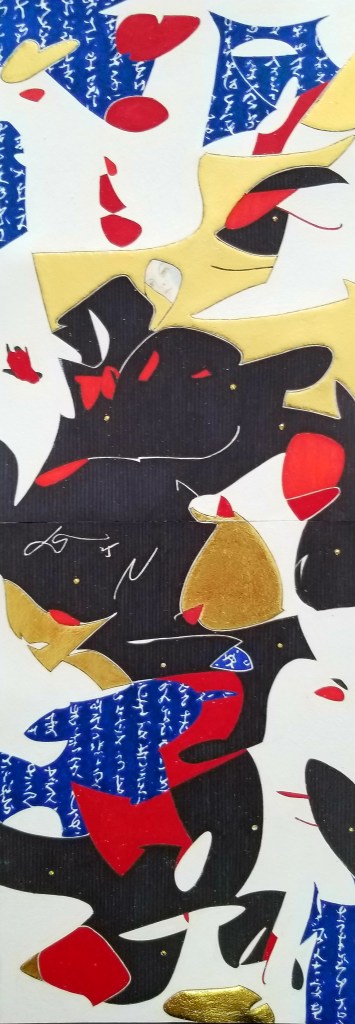
Adding to the regular productions, I am blending a feel of Chinese calligraphy into the compositions. I find calligraphy to be an art bound by the linguistic angle throughout the centuries. Could we appreciate the flow of lines over the readability of the works?
Since Automatic drawing and Asemic writing comes under the same discipline, it is logical that they be presented as complementary art approach. I dug into my ethnic roots and introduced hints of Oriental calligraphy, eliminating the linguistic context as an alternate approach in Automatic Writing – a cultural diversity approach from the commonly Latin-based Asemic presentations.
In 2025 – 2027, Seven of my works shall be a part of the Art Gallery of Alberta TREX travelling exhibition throughout the Province of Alberta, Canada.
What makes my work immortal?
Without an underlying concept reflecting our being, any art is just an image. After centuries of Realisms and Abstractions, our subconscious ought to be the next territory to explore.
L’automatisme is my underlying foundation. I am the only living artist who can extract compositions, without alterations (not rendering), from a page of subconscious line scribble. The over sixty pieces produced in the last 8 years is a living proof of this aptitude.
Every normal human throughout time has experienced a yearn for that higher order of beauty. Art that inspires and transcends answers to the spiritual need in us; a hidden grace is still essential for a work to live. Like melody in music, beauty is the attraction that lies within the works and resonate in the hearts.
When one sees beauty, the heart nods. It’s simple. It transcends and captivates directly on sight. My works possesses such charisma.
And finally…
The present Art scene is noise, man with greatness see beyond.
It is the inner grace/melody that carries a collection of works to last the generations; without which, our beneficiary would only find nostalgia reasons to safekeep and not hum to the music to find their belonging.
 kirestudio